Noodle 0.9.4 makes common request preparation easier to reuse. Keep scripts in JavaScript files when they grow beyond a short YAML block, or use body placeholders when all you need is fresh test data or a timestamp. Searchable completion menus help you find variables and methods as you edit.
Reuse JavaScript files
A request, folder, or collection can now reference a .js file for any script
phase:
scripts: pre: ./scripts/prepare.js post: ./scripts/process.jstests: ./scripts/check-response.jsEvery path starts at the collection root, even from a nested request. You can mix inline blocks and file references, or point several requests at the same file. Each invocation still gets its own sandbox, with the existing async APIs and test matchers.
Noodle checks applicable sources before a manual send and all selected sources before a collection run starts HTTP. Files must be readable, valid UTF-8, regular files no larger than 256 KiB, and confined to the collection. Reads are shared within a run; the next send picks up edits. The sandbox gets source text, without filesystem access or module loading.
The external-script examples cover preparation, response processing, tests, inherited hooks, and chaining.
Generate values in the body
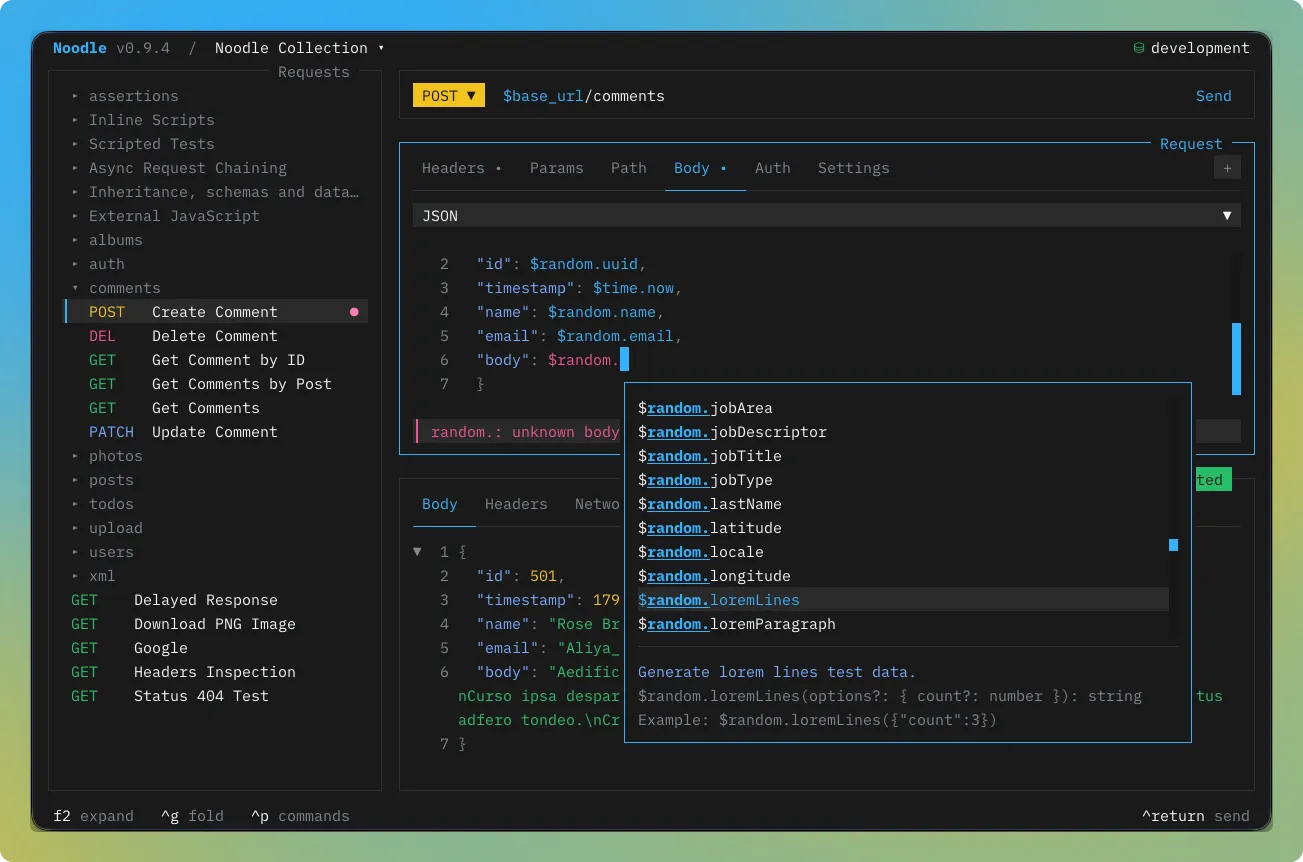
For simple generated data, write the placeholders directly in the body:
body_type: jsonbody: |- { "id": "$random.uuid", "email": "$random.exampleEmail()", "age": $random.number({"min":18,"max":80}), "active": $random.boolean, "createdAt": $time.iso, "timestampMs": $time.now }Standalone JSON placeholders keep their generated type. Quoted placeholders insert escaped text. The same helpers work in text/XML bodies and enabled text form values, with JSON-literal arguments and the existing random and time method validation. Generated passwords enter secret redaction automatically.
Values expand once before pre scripts, and redirects reuse the prepared body. Current-time placeholders share one instant within each request execution. Saved child requests and dataset iterations generate their own values. Saved YAML keeps the templates, and editor validation and completion do not generate data.
Type $random. or $time. in a supported body field to explore methods,
signatures, and examples without setting up an environment. Variable,
response-expression, and path menus are also searchable and scrollable, with
highlighted matches and mouse selection. Completion preserves exact variable
tokens and existing call arguments, and bounds its rendering for long lists.
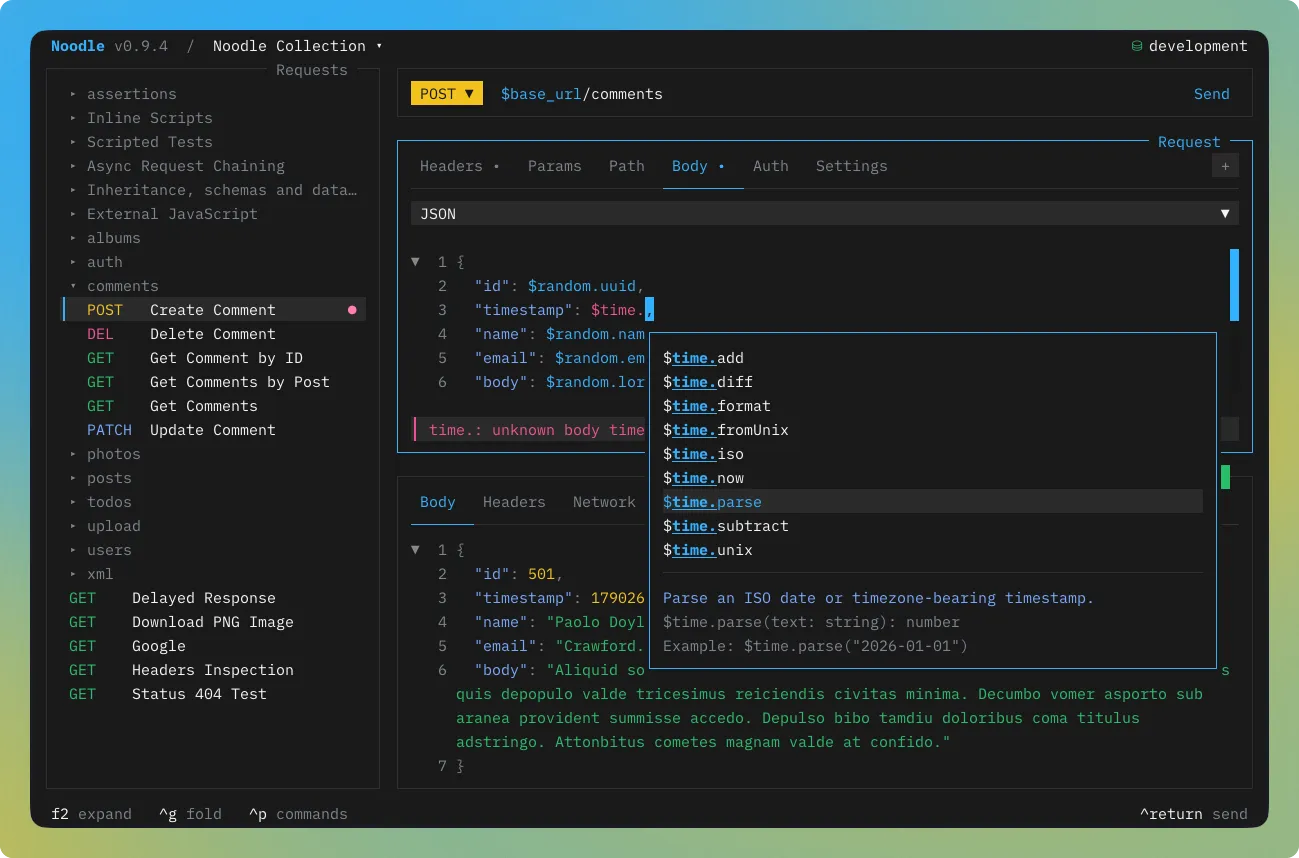
See body templates for quoting, escaping, supported fields, and lifecycle details.
Check inherited post order when upgrading
Post-response scripts now run from the request outward:
- Request post.
- Nearest folder post, then each outer folder.
- Collection post.
Captures still run before post scripts. Pre scripts and tests keep their collection-to-request order. If a post block relied on values written by a parent scope in 0.9.3, review that dependency before upgrading.
Results, CLI output, and manual history identify scope IDs, inline or external sources, and collection-relative JavaScript paths. Test invocation details remain available even for a block with no declared tests. Timeline truncation also preserves safe script and test logs alongside redaction and size limits.
Read warnings without rushing
Postman and Insomnia imports now identify scripts that were not converted, including the source item and phase. Supported requests still import, but foreign script APIs are not translated or copied into Noodle scripts.
Open Ctrl+P → Show Last Notification to read the latest message in a persistent, keyboard-scrollable view, even after the toast disappears. Notifications fit small terminals and leave editor focus intact. Import warnings and completed test status are clearer in their summaries.
Cookie storage also recovers on a later request after a temporary lock clears. While storage is unavailable, Noodle omits stored cookies and ignores response cookies, preserving the stored jar.
The updated noodle-use skill covers authoring and automation, and noodle-dev
covers source resolution, body templates, completion, and regression checks.
Start with Scripting and
Scripted Tests for the full contract.